The third lesson.
By now you know the 16 figures of the Abjad circle. These 16 figures are divided into four groups according to their actions. First learn to recognise them.
Number 1.
Exiting figures
Of the sixteen Raml figures
Figures with a single in the fire position and a double in the earth position.
Number 2.
Entering figures
Figures that have a double in the fire position and a single in the earth position.
Number 3.
Mobile figures
Figures with a single in both the fire and the earth position.
Number 4.
Fixed figures
Figures that have a double in both the fire and the earth position.
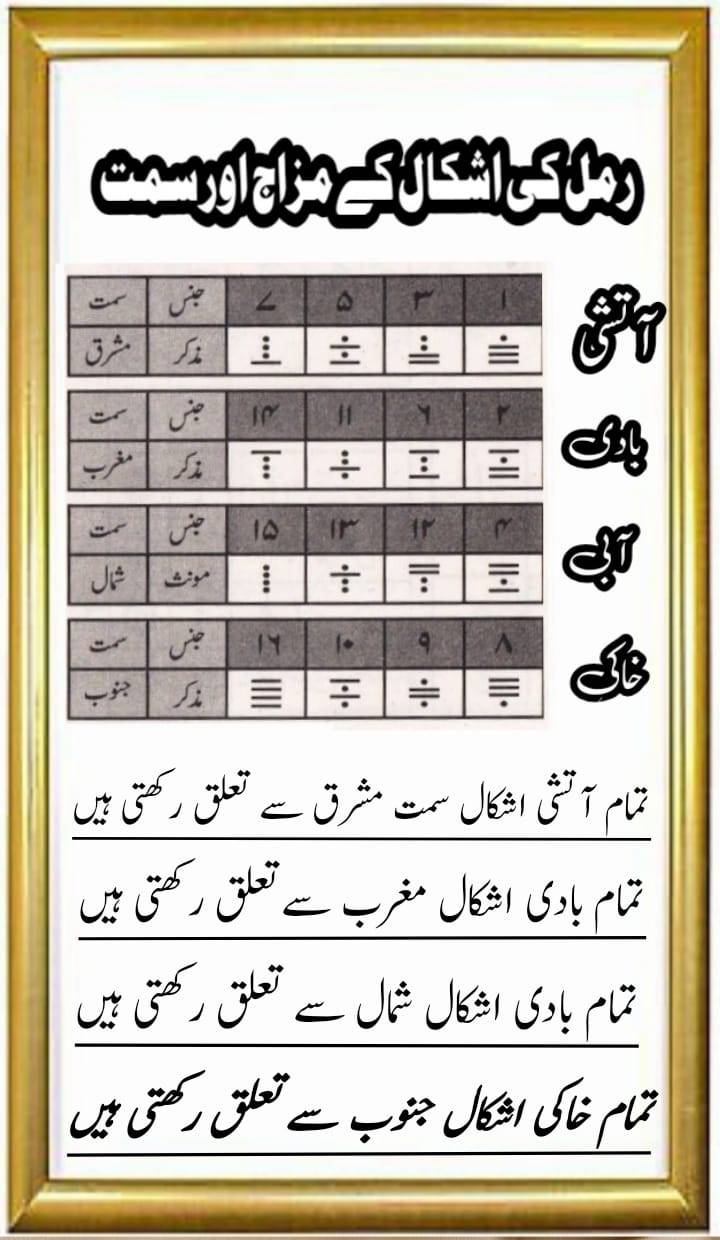
Actions of the figures
1. Exiting figures are a sign of not attaining the aim — for example separation and parting, travel, and money being spent and going out.
The exiting figures are further divided into two parts.
Fortunate exiting
and
Unfortunate exiting
Fortunate exiting figures are a sign of travelling and spending money gladly and of one's own will, or of giving something and sending it out of one's home.
The fortunate exiting figures are Lihyan and Nusrat al-Kharij.
Unfortunate exiting figures, however, are a sign of grief, pain and compulsion: useless travel or spending money unwillingly, and money being stolen, etc.
The fortunate exiting figures are Lihyan and Nusrat al-Kharij.
while among the unfortunate exiting
Qabd al-Kharij and Atabat al-Kharij are included.
2. Entering figures
are a sign of attaining the aim: the arrival and abundance of money, returning home from a journey, a message arriving from someone, and meeting.
Entering figures are also of two kinds.
Fortunate entering
and
Unfortunate entering
Fortunate entering figures are a sign of attaining the aim easily and as you wish.
The fortunate entering figures are Qabd al-Dakhil, Nusrat al-Dakhil and Atabat al-Dakhil
Unfortunate entering figures, however, are a sign of attaining the aim against your will and with difficulty
The fortunate entering figures are Qabd al-Dakhil, Nusrat al-Dakhil and Atabat al-Dakhil
while the unfortunate entering figure is Ankis
3. Mobile figures are a sign of change and alteration in matters: sometimes entering, sometimes exiting — the reverse becoming straight and the straight becoming reverse. For example, a healthy person falls ill and a sick person becomes healthy.
They too have kinds.
Fortunate mobile and unfortunate mobile
Fortunate mobile figures are a sign of easy and positive change.
The fortunate mobile figures include Farah and Tariq
Unfortunate mobile figures are a sign of hard and painful change.
The fortunate mobile figures include Farah and Tariq
while the unfortunate mobile figures include Uqlah and Naqi.
Fixed figures are a sign of standstill in matters: things stay as they are, without change, going out or coming in.
They too have three kinds
Fortunate fixed, mixed fixed and unfortunate fixed
Fortunate fixed figures are a sign of positive standstill.
Mixed fixed figures turn between unfortunate and fortunate over time. Their action differs in the different houses of the chart: in a fortunate house they are a sign of positive standstill, in an unfortunate house a sign of unfortunate standstill
Unfortunate fixed figures, on the other hand, are a sign of a hard negative standstill.
Unfortunate fixed has only one figure, Humrah.
The fortunate fixed figure is Bayad.
The mixed fixed figures are Ijtima and Jamaat.
To make it easy for friends I have made a shortcut code that lets you tell the unfortunate and fortunate figures apart among the sixteen.
گ
The code is
25789.13
Memorise this code and you will remember all the unfortunate figures at once: figures number 2, 5, 7, 8, 9, 13 are unfortunate; the rest are fortunate.
You can remember it like this
Twenty-five thousand seven hundred and ninety-nine point thirteen.
Surely you will like this effort too.