Arranged and compiled by
Muhammad Shafiq Mughal
This science has 16 figures and 16 houses, but 12 houses are read — as with astrology so with Raml. But astrology needs the name, birthplace and time, while Raml needs nothing.
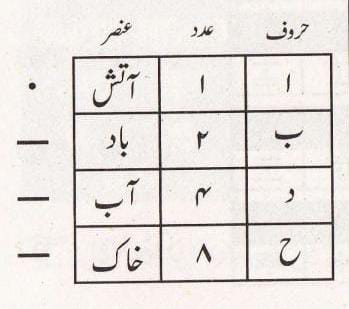
The ABDH order you see in the chart can never change; whatever figure is at a number stays there
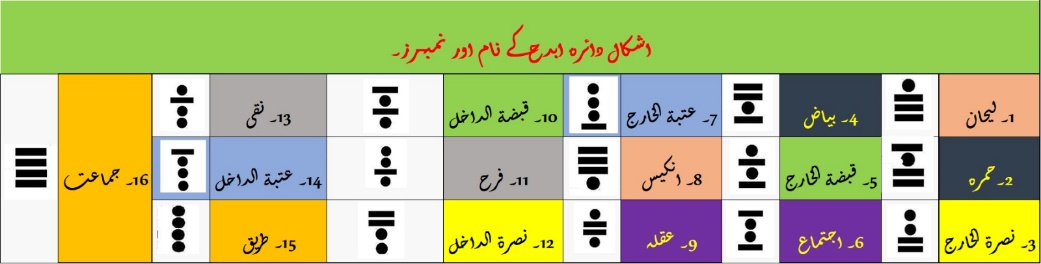
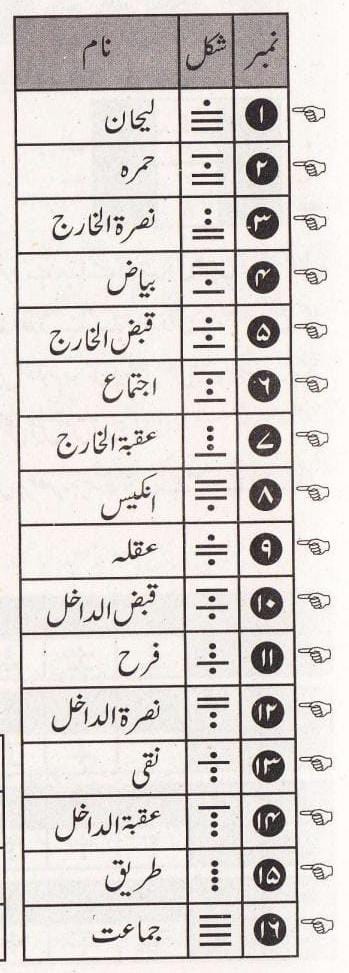
This is the ABDH chart; look in it at how a figure is formed. The principle: coming down from the top are Alif, Ba, Dal (and Ha). You write: against Alif one, against Ba two, against Dal its value four, and against Ha its value eight. Whenever a figure is formed, wherever its number falls in this order a dot is placed. That dot indicates its number in the ABDH order — for example, this is the first figure because its number is one, so one dot is placed at the very top, as that alone makes one; the remaining three places, Ba, Dal and Ha, get lines below
The figures are of four kinds
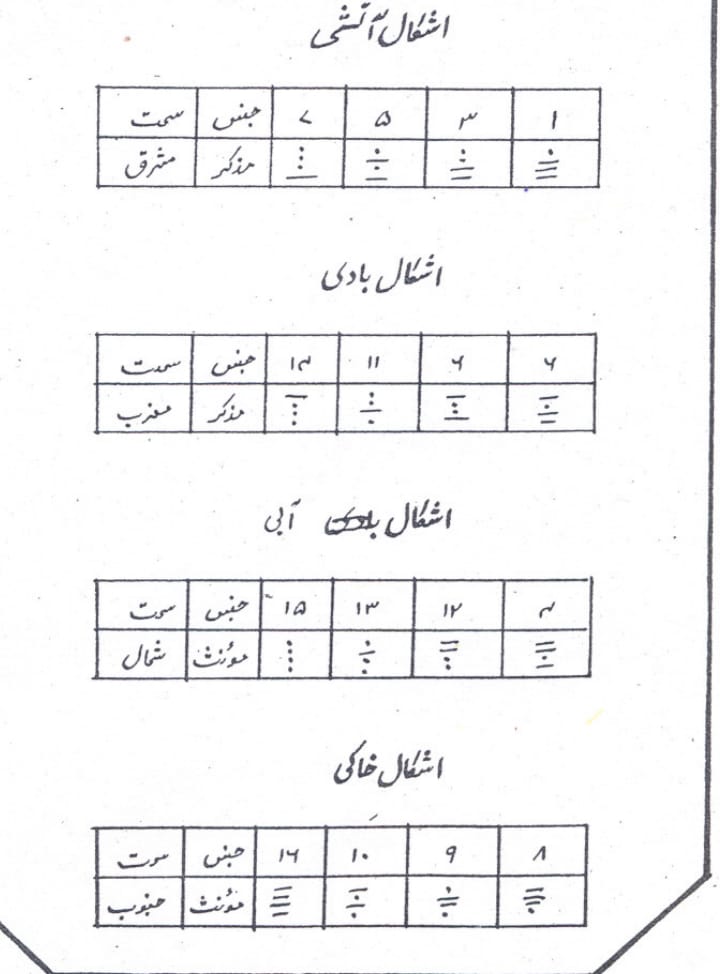
Exiting
Turning
Entering
Fixed
The 16 figures are divided into four groups according to their functions. First learn to recognise them.
| Water–water: one soul Water–fire: enemies Water–air: enemies Water–earth: friends | Fire–fire: one soul Fire–air: friends Fire–water: enemies Fire–earth: neutral |
| Earth–earth: one soul Earth–fire: enemies Earth–air: neutral Earth–water: friends | Air–air: one soul Air–fire: friends Air–water: enemies Air–earth: neutral |
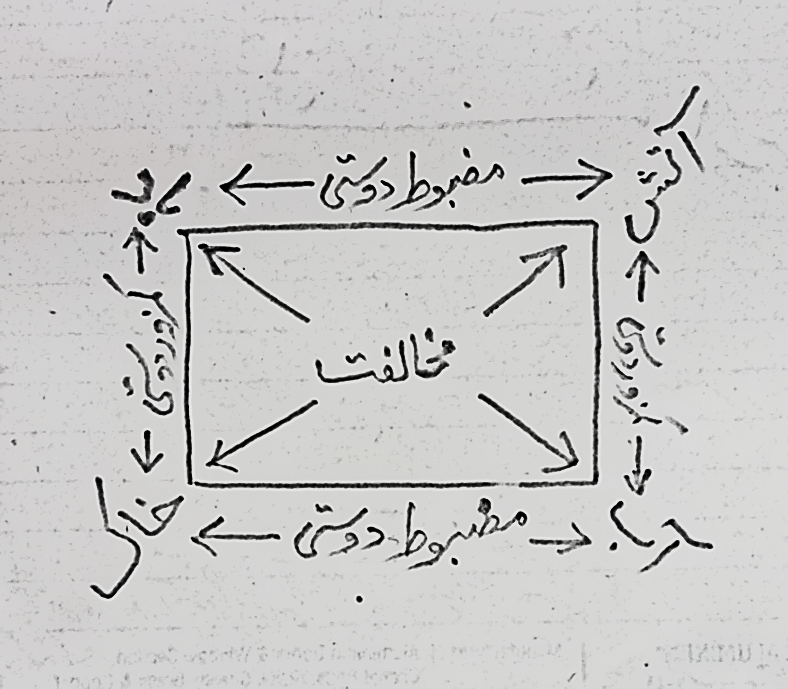
In short: if an earthy figure falls in a fiery house, that figure will be very weak; if a fiery figure falls in an earthy house, it will be very weak there.
Likewise, if a water figure comes in an air house it will be very weak, and an air figure in a water house will be very weak there. In the other houses the figures will be of roughly balanced strength. And if a figure of the same element is in a house, it will be very strong.
| Entering figures Figures that have a double in the fire position and a single in the earth position. are a sign of attaining the aim: the arrival and abundance of money, returning home from a journey, a message arriving from someone, and meeting. Entering figures are also of two kinds. Fortunate entering and Unfortunate entering Fortunate entering figures are a sign of attaining the aim easily and as you wish. The fortunate entering figures are Qabd al-Dakhil, Nusrat al-Dakhil and Atabat al-Dakhil Unfortunate entering figures, however, are a sign of attaining the aim against your will and with difficulty while the unfortunate entering figure is Ankis | Exiting figures / figures with an odd count at the fire position and an even count at the earth position / Exiting figures signify not obtaining the wish — for example separation and parting, travel, and money being spent and going. / Exiting figures are further divided into two. / Fortunate exiting / and / unfortunate exiting / Fortunate exiting signifies travelling gladly and by choice, spending money or giving something, and sending something out of one's house. / Fortunate exiting figures are Lihyan and Nusrat al-Kharij. / Unfortunate exiting signifies useless travel or spending money with grief, pain and compulsion, against one's will, and money being stolen etc. / Unfortunate exiting includes / Qabd al-Kharij and Atabat al-Kharij. |
| Fixed figures / figures with an even count at both the fire and earth positions. / Fixed figures signify stability in affairs: a matter will stay as it is, with no change, exit or entry. / They too have three kinds / fortunate fixed, mixed fixed and unfortunate fixed / Fortunate fixed signifies positive stability. / Mixed fixed changes between unfortunate and fortunate with time; their action differs in the various houses of the chart. In a fortunate house they signify positive stability and in an unfortunate house unfortunate stability / while unfortunate fixed figures signify harsh negative stability. / Unfortunate fixed has only one figure, Humrah. / Fortunate fixed is Bayad. / Mixed fixed are Ijtima and Jamaat. | Turning figures / figures with an odd count at both the fire and earth positions. / 3. Turning figures signify change and alteration in affairs — sometimes entering, sometimes exiting; the reversed becoming straight and the straight reversed. For example, the healthy fall ill and the ill become healthy. / They too have kinds. / Fortunate turning and unfortunate turning / Fortunate turning signifies easy and positive change. / Fortunate turning includes Farah and Tariq / Unfortunate turning signifies difficult and painful change. / Unfortunate turning includes Uqlah and Naqi. / Shortcut code: fortunate and unfortunate will be told apart. / Figures 2, 5, 7, 8, 9, 13 are unfortunate / the rest are fortunate. Twenty-five thousand seven hundred ninety-nine point thirteen. |
Fire and air figures are living and masculine
Water and earth figures are dead and feminine
The order for memorising the figures.
Every figure with a dot at the very top — a dot only at the top — is an exiting figure.
Fortunate exiting: Lihyan and Nusrat al-Kharij
Unfortunate exiting: Qabd al-Kharij and Atabat al-Kharij
Every figure with a dot at the very bottom — a dot only at the bottom — is an entering figure
The fortunate entering figures are Qabd al-Dakhil, Nusrat al-Dakhil and Atabat al-Dakhil
while the unfortunate entering figure is Ankis
Every figure that has a dot at the top and a dot at the bottom is called turning
The fortunate mobile figures include Farah and Tariq
Unfortunate turning includes Uqlah and Naqi.
Every figure that has a line at the top and a line at the bottom is called fixed
There are three kinds
Unfortunate fixed has only one figure, Humrah.
The fortunate fixed figure is Bayad.
The mixed fixed figures are Ijtima and Jamaat.
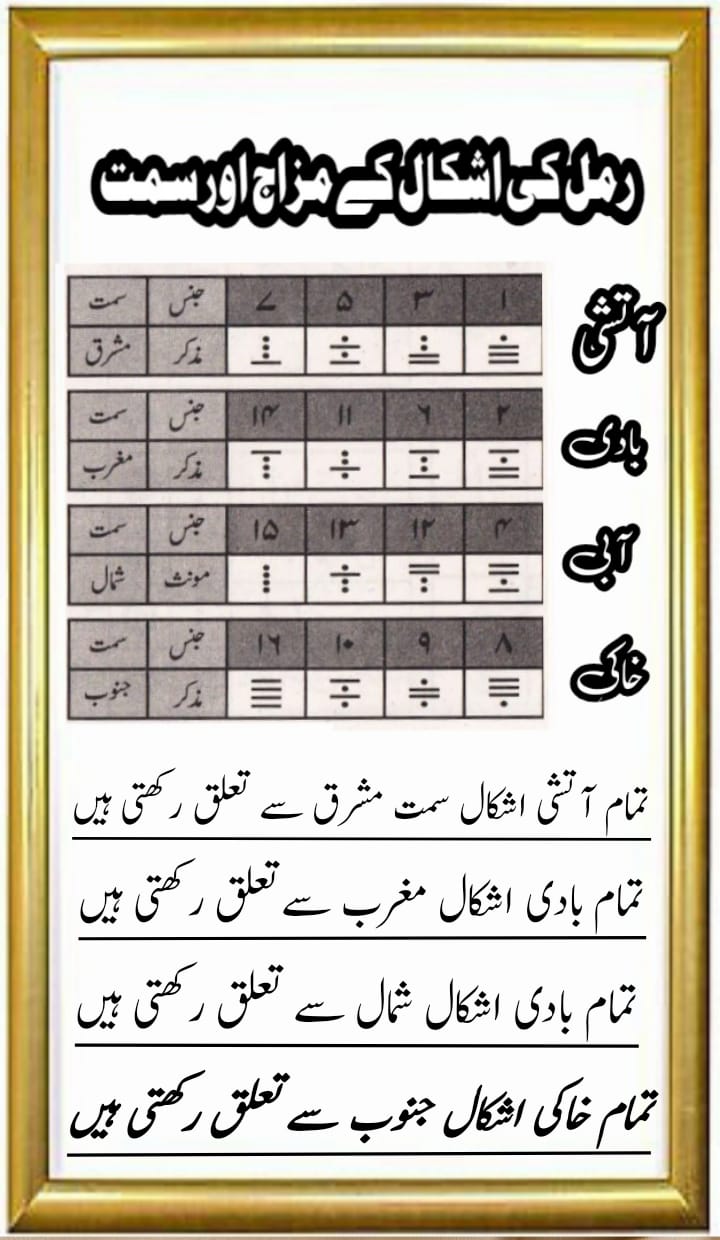
Fire figure =========== East
Air figure =========== West
Water figure =========== North
Earth figure =========== South
Whatever element a figure belongs to, it will tell that direction in that house
Example: if Lihyan comes in the thief's house, it means the thief went east; understand the rest likewise
If an earth figure comes in house 9, the enquirer gains more from travel in the southern direction
No question in the world lies outside these four kinds; take any question and it will fall within them
For example, travel relates to exiting — going out, leaving. Likewise marriage relates to entering: whether a marriage will happen concerns meeting and obtaining, so such questions come under entering. Similarly, should I do this work or not, should I go there or not — a matter one cannot understand, cannot settle on, with restlessness — such questions come under turning. And finally, questions about what will last a long time, such as whether this agreement will hold or whether this house will be built — every matter meant to last long comes under the fixed kind